
When Systems Meet Scale
Why Athletica Was Built as a System, Not an App: The Computational Sports Science LAB

Over the past few weeks, many of you will have noticed turbulence across the Athletica platform.
That wasn’t noise. It was signal.
A new interface, deeper system integration, and a fully embedded AI Coach chat attracted more athletes, more data, and more simultaneous demand than we had ever experienced. The result was stress on parts of the system that, until now, had never been tested at that scale.
That’s uncomfortable in the moment. But it also tells you something important.
It tells you the system matters.
Now that things are largely settled (notwithstanding latest Workout Wizard upgrade in beta mode), this feels like the right time to step back and explain what Athletica actually is, how it thinks, and why this phase mattered.
Athletica Is Not an App
It’s not a chatbot.
It’s not a dashboard.
And it’s not a collection of static training plans.
At its core, Athletica is a sports science laboratory running continuously in the background. It uses accumulated athlete data to estimate things that traditionally required lab testing, expert interpretation, and time.
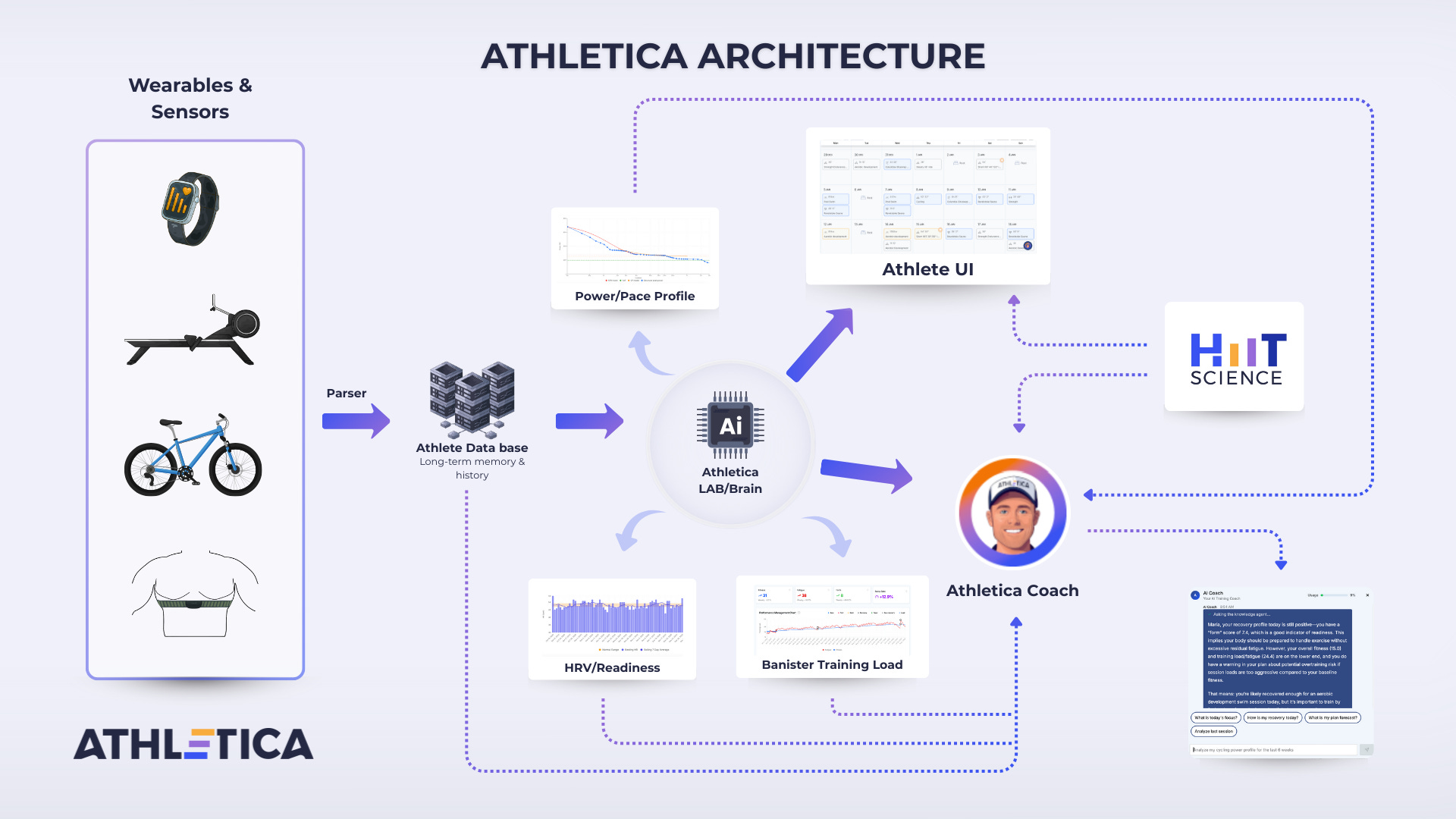
Data from wearables and devices does not flow directly to a screen or an AI response. It is first parsed, organised, and accumulated into a longitudinal athlete record that captures training history, responses, and trends. This record provides context: what you have done, how your body responded, and how those responses are changing over time. Without that history, a system can only reflect raw data in the moment. It cannot reason about adaptation.
At the center of this system sits what we internally call the LAB.
The LAB: Where Meaning Is Computed
The LAB is where training theory becomes computation.
This is where we estimate, over time:
Power and pace profiles into training zones
Aerobic capacity and anaerobic speed reserve
Training load optimisation using Banister-style models
Fatigue, readiness, and adaptation signals via HRV
Longitudinal responses to training stress
These are not features you click on. They are physiological estimates derived from how your body responds to training across weeks, months, and years, and available for analysis by your Athletica Coach.
In the system diagram (Figure 1), you’ll see metrics like training load, profiling, and HRV placed around the LAB. That placement is intentional. These are not inputs. They are outcomes.
This is why Athletica behaves differently from most platforms. It reasons over history. It carries memory. It accumulates context. The fundamental HIIT Science principle we’ve strived to deliver since day 1.
Where the Athletica Coach Actually Fits
The Athletica Coach (your AI Coach) does not replace the LAB.
It sits on top of it.
Its role is interpretation, explanation, and guidance grounded in laboratory outputs. That distinction matters. Without a strong underlying model, AI becomes persuasive but shallow. With one, it becomes useful.
When you ask the Athletica Coach to analyse a session, your recovery, your pacing strategy, or your future potential, it isn’t guessing. It’s translating computed estimates into language you can act on.
That translation layer is new. And like any interface between complex systems and humans, it takes iteration to get right.
A Leadership Call, Made Together
I want to be clear about something.
I made the call to launch.
Not knowing exactly what would happen. But knowing that we had reached the point where theory, internal testing, and caution were no longer enough.
Athletes and coaches learn through exposure. Through mistakes. Through trial and error. I knew, in my heart of hearts, that we had to venture into the unknown if this system was ever going to become real.
So for better or worse, I made the call. The team actioned the release. And we entered the steep end of the learning curve together.
No blame.
No finger-pointing.
Just focus, teamwork, and long hours.
Moment by moment, we stabilised. And now, here we are.
A Word on the Team
None of what you’re seeing now happened by accident.
Over recent weeks, a small, deeply committed group of engineers, sport scientists, and product thinkers worked relentlessly to reinforce the system under live conditions. They didn’t just patch issues. They strengthened foundations.
Real systems aren’t proven in demos. They’re proven under load.
This team proved itself.
What the New Athletica Experience Means for You
If you’re an athlete, the only thing that really matters is whether your training works.
Not explanations. Not roadmaps. Outcomes.
Here’s what’s different now.
Athletica can support you wherever you are on your journey. If you’re new to structured training, the system now builds programs that are genuinely approachable, progressive, and sustainable. If you’re experienced, nothing has been watered down. The same physiological models still drive the work.
The Athletica Coach is no longer limited to narrow questions. You can ask about your recent sessions, your recovery, niggles you’ve flagged in the past, pacing decisions, longer-term development, or what it would take to reach your next level. You can also be guided toward Athletica U content that helps you understand why you’re doing the work, not just what to do.
What ties all of this together is that the system now reasons over your training history more reliably. It sees patterns, not just sessions. That means better decisions, clearer guidance, and fewer surprises.
The science held. The engineering learned. And the experience for you is now stronger because of it.
Why This Moment Matters
What we experienced wasn’t unique to Athletica. It’s a natural consequence of where endurance training technology is heading.
Everyone will claim to have an AI coach. We’re already seeing it. But not all “AI” is doing the same work.
Many platforms focus on displaying data more clearly, automating static plans, or answering questions in isolation. Those approaches scale easily because they don’t require the system to reason over an athlete’s history.
Athletica was built to do something harder: to model how athletes adapt over time.
The moment you move from showing data to computing adaptation, the problem changes. You’re no longer optimising interfaces. You’re maintaining physiological models, historical memory, and internal consistency across weeks, months, and seasons.
That shift creates new demands. Accuracy, validity, and reliability stop being academic ideals and become operational requirements. The system has to be right often enough, and stable long enough, to earn trust.
The recent period made that clear. And it also clarified the opportunity.
This is what Sports Science 3.0 looks like when it leaves the lab and meets real athletes at scale.
Where We Are Now
If you’ve done advanced training in sport science, you’ll recognise the principle we’ve come full circle to.
Accuracy.
Validity.
Reliability.
Our collective focus for Q1 here and now is simple and non-negotiable: trust in the system. Reliability first. Confidence earned quietly, through repetition and consistency.
That’s not the glamorous phase. It’s the necessary one.
And Finally, the Community
None of this would have been possible without the thousands of athletes who stuck with us, reported issues, asked hard questions, and helped us see what mattered most.
You made the system better.
If you’re interested in where training science goes when it becomes computational, you’re welcome here. All are.
The figure accompanying this piece isn’t marketing artwork. It’s a system diagram. And if you understand it, you understand the path we’ve chosen.
More soon.
Paul